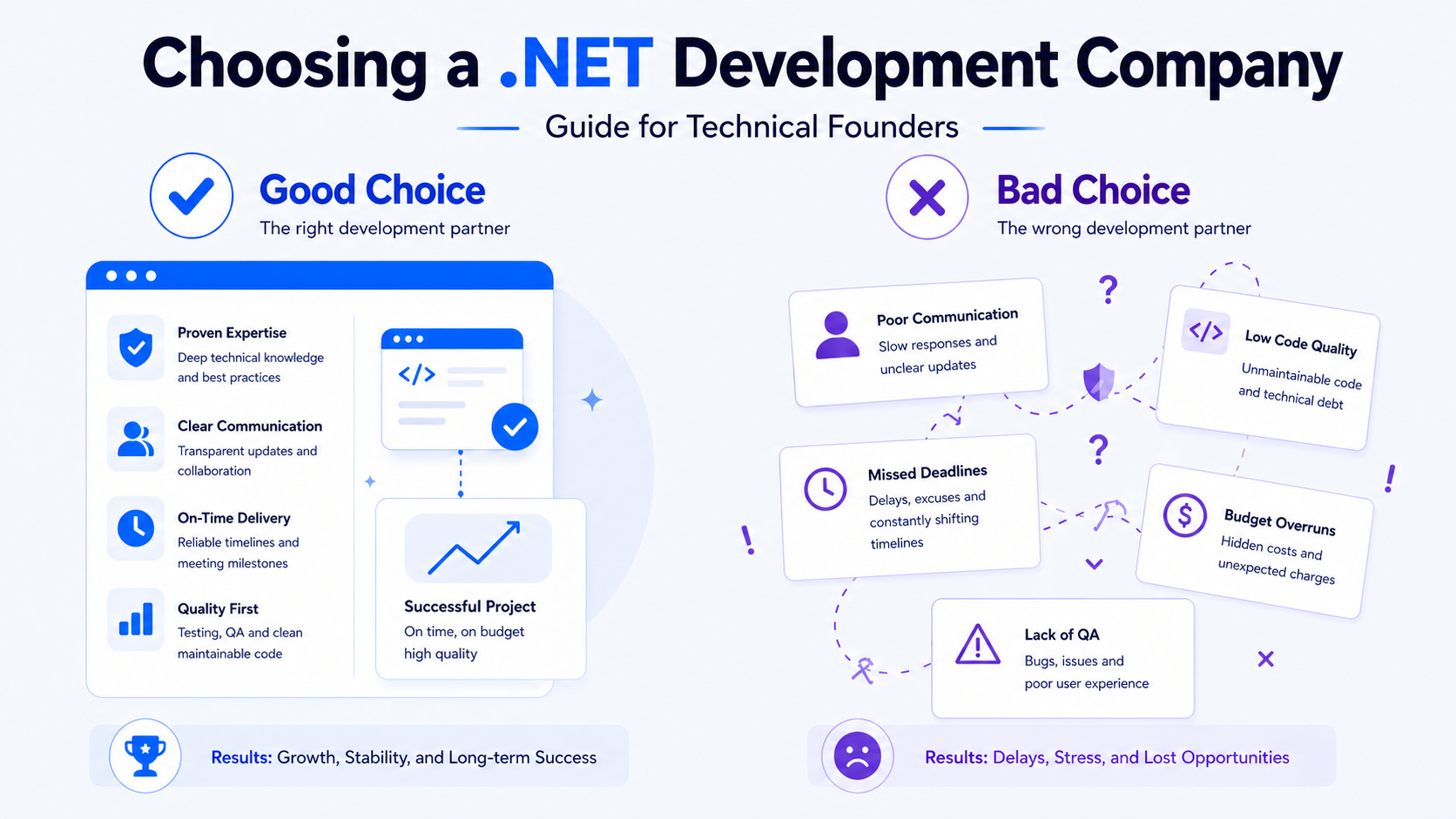
How to Choose a .NET Development Company: A Practical Guide for Technical Founders
Table of Contents
Too many CTOs inherit 'finished' .NET projects that require a complete rewrite. Choosing the wrong .NET development partner is expensive - not just in wasted money, but in time lost, mounting technical debt, and product releases that keep slipping. If you've been through that once, you're reading this for a reason.
This guide provides a direct, no-fluff framework for evaluating custom .NET development services. Whether you're replacing a team that underdelivered, scaling your platform, or outsourcing for the first time, this is how you separate the engineers from the order-takers.
What "Custom .NET Development Services" Actually Covers
The term gets used loosely. In practice, a full-service .NET development company covers:
Web application development: ASP.NET Core APIs, Blazor frontends, MVC apps
E-commerce platforms: Custom storefronts, Shopify integrations, Amazon SP API connections
CMS development: Umbraco, custom content architecture, migration from legacy CMS
Cloud and DevOps: Azure and AWS deployment, CI/CD pipelines, infrastructure automation
QA and test automation: Manual and automated testing, regression suites, coverage reporting
Legacy modernization: Upgrading .NET Framework apps to .NET 6/7/8, refactoring aging codebases
The companies that do all of this well under one roof are rare. Most agencies specialize in 2-3 of these areas and subcontract or underdeliver on the rest. It's worth asking upfront which of these they treat as core and which they treat as add-ons.
5 Signs a .NET Agency Is Worth Hiring
They ask about your codebase before quoting
Any senior-led team wants to understand what they're walking into - not just what you want to build. If they jump straight to pricing without asking about your current architecture, tech debt, or test coverage, that's a miss.QA is built in, not bolted on
The best .NET development companies run automated tests on every commit and treat regression coverage as a delivery standard, not a final-phase checkbox. Ask them directly: "What does your QA process look like between sprints?" The answer reveals a lot.Seniors lead the work - not just the sales calls
A common pattern in offshore development: senior engineers close the deal, juniors do the work. Ask who specifically will be writing code on your project and what their individual experience levels are. A team with 10+ years per engineer operates very differently from one that uses juniors on delivery.They communicate in your time zone
Async-first communication works fine for day-to-day work, but you need overlap for code reviews, architecture decisions, and anything urgent. Good agencies plan their schedules around client time zones, not just their own.They push back when something doesn't make sense
A partner worth hiring will challenge a bad requirement. If every estimate comes back as "yes, we can do that" with no questions asked, you're working with order-takers, not engineers.
5 Red Flags to Walk Away From
Junior-heavy teams on critical delivery
If a .NET agency can't tell you the seniority breakdown of who touches your code, assume it's weighted toward junior developers. The cost savings evaporate quickly when senior time gets absorbed fixing junior mistakes.No CI/CD or automated testing in their process
In 2026, any credible .NET development company runs CI/CD pipelines as standard. If they describe their testing process as "we test before release," that's a manual-only QA culture - and a sign of unpredictable releases.Vague portfolio or NDA-everything approach
Legitimate agencies protect client details, but they can still share anonymized case studies, architecture diagrams, or technology specifics. If a company can't show you any concrete evidence of past work, there may not be much to show.Fixed-price everything
Fixed-price contracts put pressure on agencies to cut scope, rush delivery, or both. Time-and-materials or milestone-based models with clear scope definitions tend to produce better outcomes for complex .NET projects.They've never heard of your stack
If your project involves Umbraco, Shopify GraphQL APIs, or Azure Service Bus and the agency gives you a blank look, they're going to learn on your dime. Specialization matters.
Onshore vs. Offshore vs. Nearshore: Which Model Fits?
Model | Cost | Time Zone Overlap | Risk |
Onshore (UK/US/AU) | High | Full | Low |
Nearshore (Eastern Europe) | Medium | Partial | Medium |
Offshore (India) | Low–Medium | Limited (but manageable) | Variable |
Offshore isn't the risk it was 10 years ago - provided you choose a senior-led team with strong English communication and documented processes. The cost advantage is real: offshore .NET development typically runs 40–60% less than equivalent onshore rates. The key variable is team quality, not geography.
The best offshore .NET companies compensate for time zone gaps with strong async practices: clear tickets, documented decisions, regular written updates, and scheduled overlap windows for live collaboration. Ask any potential partner to describe exactly how they handle urgent issues that come up outside their working hours.
Questions to Ask Before You Sign Anything
These questions separate serious .NET development companies from the rest:
On team composition:
Who specifically will write code on my project? What is their seniority level?
Will the same team work on my project end-to-end, or will members rotate?
On process and quality:
What does your CI/CD pipeline look like?
How do you handle automated testing - what's a typical coverage target?
How do you manage scope changes mid-project?
On communication:
What time zone are your developers in, and what hours do you overlap with [your timezone]?
How do you communicate progress - daily standups, written updates, or something else?
On past work:
Can you share examples of similar projects - even anonymized ones?
Have you worked with [your specific stack - e.g. Umbraco, Shopify, Azure]?
On commercials:
What engagement model do you use - fixed price, T&M, or dedicated team?
What happens if we need to scale the team up or down mid-engagement?
Any experienced team should answer these comfortably and specifically. Vague answers are data.
How Atharva IT Services Approaches .NET Delivery
Atharva IT Services is a senior-led .NET development company based in Ahmedabad, India, working with clients across the UK, US, Europe, and Australia.
Every project at Atharva ITS is handled by senior engineers with 10+ years of enterprise .NET experience. There are no junior developers on delivery work. QA and test automation are built into the workflow, not added at the end. And CI/CD pipelines are standard on every engagement - not an optional extra.
If you're evaluating .NET development partners or dealing with a stalled project, request a Technical Assessment or book a 15-minute Discovery Call. We'll give you an honest, engineer-to-engineer evaluation of your architecture, team needs, and a realistic estimate - no fluff, no obligation.
Conclusion
The right .NET development company asks hard questions before writing a line of code. They staff projects with senior engineers, build QA into the delivery process, and communicate with the same discipline they expect in code. Use the criteria in this guide as your evaluation checklist - the agencies that hold up under scrutiny are the ones worth working with.
Related Blogs

Introduction To Rate Limiting Middleware in ASP.NET Core
Discover how rate limiting middleware boosts performance in ASP.NET Core
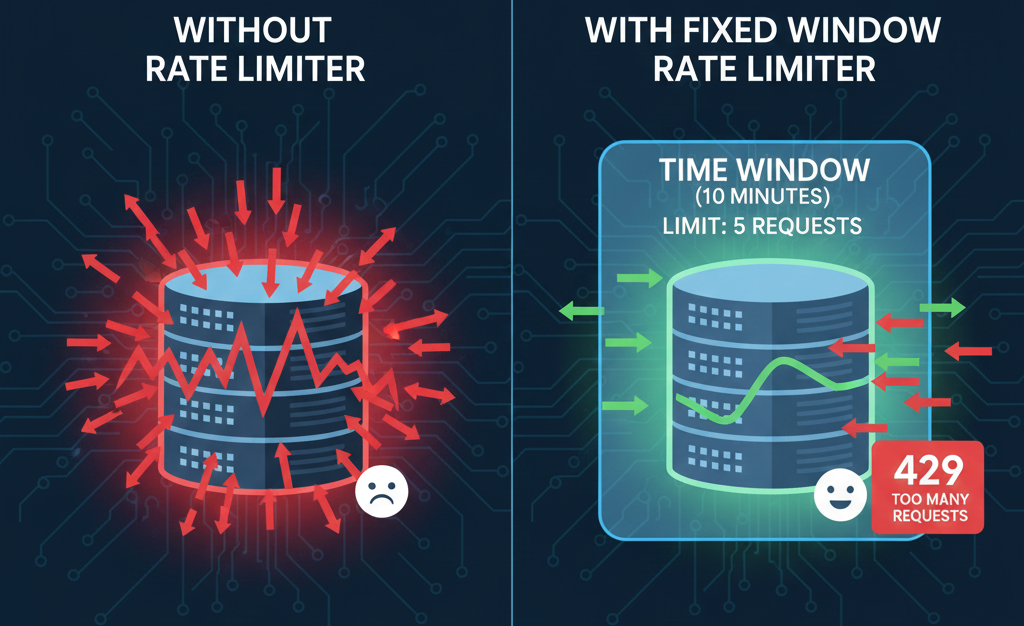
Fixed Window Rate Limiter in ASP.NET Core
How the Fixed Window Rate Limiter keeps ASP.NET Core APIs stable and controlled.

Sliding Window Rate Limiter in ASP.NET Core: What is it and when to use it?
Sliding Window Rate Limiting to balance bursty traffic and protect ASP.NET Core APIs.